

Beverage manufacturers face growing pressure to increase throughput, improve product consistency, reduce water consumption, and meet increasingly stringent food safety requirements. Whether producing beer, wine, or juice, filtration has become a critical process step that directly impacts product quality, yield, operating costs, and production efficiency. From clarification and microbial control to final product polishing and sterile filtration, modern beverage plants rely on advanced filtration technologies to maintain product integrity while supporting sustainability and operational performance objectives.
The following report aggregates 2026 beverage industry statistics and filtration benchmarks to show how evolving market conditions are reshaping filtration demands across brewing, winemaking, and juice processing.
Why Filtration Matters in Modern Beverage Manufacturing
As beverage production volumes expand and formulation complexity increases, filtration has moved from a background utility to a core production variable. The table below summarizes the key operational objectives that filtration directly supports.
| Operational Goal | Filtration Impact |
|---|---|
| Product Consistency | Removes particulates, yeast, and haze-forming compounds batch to batch |
| Product Yield | Maximizes recoverable volume and reduces product loss per cycle |
| Food Safety | Supports microbial control and product stability |
| Water Reduction | Reduces cleaning frequency and CIP consumption |
| Sustainability | Lowers waste generation and energy use |
| Uptime | Extends service intervals and minimizes unplanned production stoppages |
Each outcome is directly tied to filtration system selection, media specification, and process configuration. For manufacturers running mixed-product lines, poor filtration management compounds the cost and complexity across every SKU.
The beverage industry statistics below show how those demands are intensifying, and how manufacturing plants are adapting to meet them.
Beverage Industry Statistics: Filtration Market and Production Benchmarks
The global beverage membrane filtration market was valued at $3.6 billion in 2023 and is projected to reach $8.2 billion by 2033, reflecting growing adoption across beer, wine, and juice production for both microbial control and clarification applications.
| Beverage Type | Primary Filtration Processes | Market Scale Driving Filtration Demand |
|---|---|---|
| Beer | Bright beer filtration, yeast removal, cold stabilization, sterile filtration, and shelf-life protection | $839.31 billion (6.8% CAGR increase by 2030) |
| Wine | Crossflow filtration, tartrate stabilization, microbial reduction, clarification, polishing | $549.6 billion (9.1% CAGR increase by 2033) |
| Juice | Clarification, pectin removal, microbial stabilization, fouling management, yield recovery | $142.10 billion (3.1% CAGR increase by 2031) |
Each of these categories presents distinct filtration challenges, and growth across all three is compounding those demands at the plant level. Higher production volumes, tighter quality standards, and increasingly complex formulations are raising the performance bar for filtration systems across every stage of the process. A set of converging consumer trends and regulatory pressures is further intensifying those requirements.
Evolving Trends and Policies Impacting Filtration Demands
Growing Non-Alcoholic Beer Market
Non-alcoholic beer production often adds a dealcoholization stage that significantly increases filtration load, replacement frequency, and CIP demand compared to conventional brewing. With the global non-alcoholic beer market valued at $24 billion in 2025 and projected to reach $52.3 billion by 2036, these added process demands are scaling rapidly across the industry.
More Demand for Functional Beverages
Functional beverages formulated with probiotics, proteins, and botanical extracts require selected filtration or low-temperature processing to preserve active ingredients, which can result in tighter micron ratings, more stringent filter validation and integrity testing (where applicable), and stricter media qualification requirements than in conventional beverage production. The global functional beverage market was valued at $164.7 billion in 2025 and is projected to reach $315.9 billion by 2033, underscoring the scale at which manufacturers are now navigating increasingly demanding filtration requirements.
Sugar Taxation Policies
Sugar taxation policies across more than 45 jurisdictions are accelerating reformulation cycles, introducing changes in beverage formulations that can affect viscosity, suspended solids, and overall process requirements, that can affect filter loading rates and media life. Under FSMA’s preventive controls framework, significant reformulation may require a reassessment of the hazard analysis and a food safety plan review, adding to the compliance burden and operational complexity.
Across all three trends, the direction is the same: more processing complexity, more frequent reformulation, and higher filtration performance requirements at every stage of production.
Plant Economics: Water Use, Yield Recovery, and Operating Cost
Filtration decisions have a direct and measurable impact on plant-level operating costs. The table below maps each operational priority to its filtration lever and the resulting plant-level impact.
| Operational Priority | Filtration Lever | Plant-Level Impact |
|---|---|---|
| Product yield recovery | Higher-efficiency clarification and polishing filtration | Reduces product loss per batch; optimized clarification and polishing filtration can improve recoverable volume by 1–3% of total batch production |
| Filter service life | Properly specified media with extended service intervals | Fewer changeouts, lower labor requirements, reduced chemical costs per cycle |
| CIP water consumption | Longer filter service intervals, reducing cleaning frequency | Cuts CIP water demand by up to 35% |
| Downtime risk | Correct media and housing specification from the start | Prevents premature filter fouling and eliminates unplanned production stoppages |
For manufacturers with both sustainability targets and cost reduction mandates, filtration system performance is where those gains are either captured or lost. Operational performance is only part of the picture. In food and beverage production, filtration also sits at the intersection of product safety and regulatory compliance, where the consequences of failure extend well beyond cost.
Food Safety and Regulatory Compliance
Beverage manufacturers operate under FDA, FSMA, and HACCP requirements that treat filtration as a critical control point. Filter media, sanitary housings, and process components must meet food-grade material standards, support CIP/SIP sanitation protocols, and provide full traceability documentation for regulatory audits.
Failures at the filtration stage carry disproportionate consequences. A microbial breakthrough at the final filtration stage can trigger a product recall, a HACCP non-conformance, or an FDA enforcement action, each of which carries costs that far exceed the cost of the filtration system itself. The average direct cost of a food or beverage product recall is $10 million, not including reputational damage or lost distribution.
Cleanova’s Role in Beverage Filtration
For beverage manufacturers navigating these operational, economic, and compliance demands, choosing the right filtration partner is critical to achieving reliable process performance and consistent product quality. From clarification and particulate removal to microbial control and final product polishing, Cleanova helps beverage manufacturers optimize filtration at every stage of the production process.
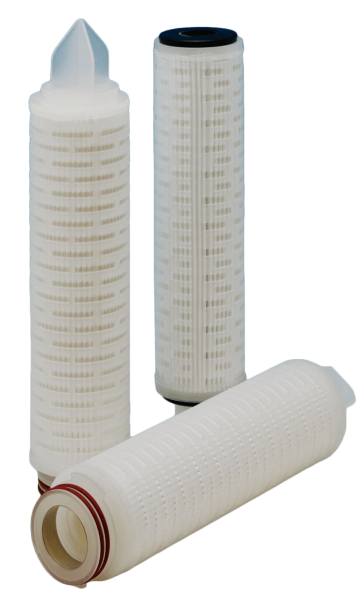
Cleanova’s expanding Food & Beverage filtration portfolio includes the CleanFine™ cartridge range for pre-filtration and membrane protection, CleanSelect™ membrane cartridges for final product filtration, and CleanPurity™ premium membrane cartridges for high-purity and microbial control applications. These solutions are complemented by Cleanova’s liquid filter bags, sanitary filter housings, industrial strainers, and engineered process filtration systems that support demanding beverage production environments.
Whether clarifying wine, improving juice quality, protecting downstream membrane filters, or supporting food safety and product stability objectives, Cleanova solutions are designed to help manufacturers improve filtration efficiency throughout the production process. By optimizing filtration performance, beverage producers can reduce product losses, improve yield recovery, extend filter service life, minimize changeout requirements, lower water and chemical consumption, and maintain consistent product quality.
Beyond supplying filtration products, Cleanova works with beverage manufacturers to optimize complete filtration processes—from pre-filtration through final product polishing—helping improve uptime, reduce operating costs, and support regulatory compliance.
Are you looking to improve filtration performance across your beverage production line?