
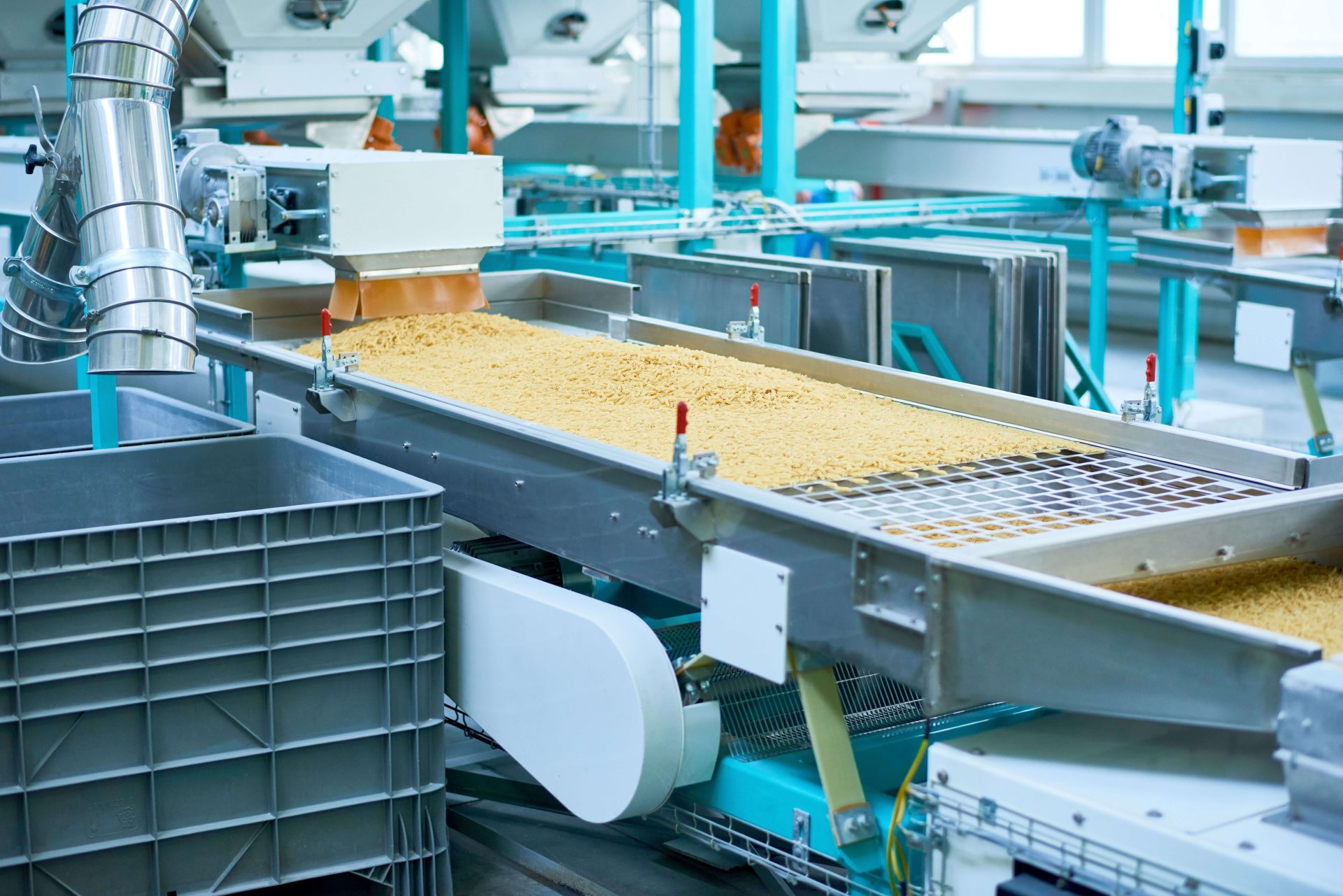
Food manufacturers face increasing pressure to improve product quality, reduce contamination risks, meet regulatory requirements, and maximize production efficiency. Selecting the right filtration technology is a critical part of achieving those objectives, but no single filtration system is ideal for every application. Understanding the strengths and limitations of each technology helps engineers design reliable, cost-effective filtration systems.
The Best Food Processing Filters
| Cartridge Filter | Crossflow / Membrane Filter | Liquid Bag Filter | |
|---|---|---|---|
| Separation Capability | 0.2–120 µm (food processing range) | 0.8–1.4 µm pore size (dairy MF) | 0.5–1500 µm |
| CIP/SIP | Housing and compatible cartridge elements can be CIP/SIP cleaned. Elements are replaced at the end of their service life | Yes | Housing only; the liquid filter bag is single-use and replaced at each service interval |
| Key Compliance Standard | FDA 21 CFR Part 177 and EU Regulation 1935/2004 | FDA 21 CFR Part 177 and EU Regulation 1935/2004 | FDA 21 CFR Part 177 and EU Regulation 1935/2004 |
| Primary F&B Application | Beverage, dairy, juice | Dairy, brewing, protein processing | Pre-filtration, general clarification |
| Maintenance Requirements | Moderate | High | Low |
| Flow Rate Range | Scales with housing count; low to high | Medium to high; system-dependent | Scales with housing size; medium to high |
| Total Cost of Ownership (TCO) | Low–Medium capital; moderate media replacement cost; change-out labor is low per event | High capital; low consumable cost; CIP/SIP protocol validation is the primary ongoing operational cost driver | Low capital; replacement frequency and disposal costs should be considered in high-TSS (total suspended solids) applications |
| Best Fit | Pre-filtration to a sterilizing-grade final stage | Microbial control and protein processing | Pre-filtration only; upstream of cartridge or membrane |
| Key Advantage | Single technology covers both pre-filtration and sterilizing-grade stages | Consistent effluent quality without heat treatment | Lowest-cost entry point for multi-stage filtration |
| Key Disadvantage | Requires upstream pre-filtration in high-solids streams | Highest capital investment and operational complexity | No microbial reduction; cannot serve as a standalone final stage |
| Typical Microbial Reduction | Sterilizing-grade (per ASTM F838) | Partial bacterial reduction (not sterilizing-grade) | None; particle removal only |
Food Processing Filter Types
Cartridge Filter: For Fine Liquid Polishing in Beverages and Dairy
Cartridge filtration controls particle retention from 0.2 to 120 μm using 21 CFR Part 177 and EU Regulation 1935/2004-compliant materials for food-contact applications. Polypropylene and polyethersulfone (PES) elements in sanitary housings with tri-clamp connections serve juice, wine, dairy, and beverage lines. Sterilizing-grade applications specify PES absolute-rated elements; an upstream pre- filter reduces cartridge loading and extends service intervals.
| Pros |
|
| Cons |
|
| Best Use Cases |
|
| When Not to Use |
|
Crossflow / Membrane Filter: For Dairy, Brewing, and Protein Processing
Crossflow microfiltration is typically specified where continuous separation and consistent permeate quality are required. In dairy applications, membranes with 0.8 to 1.4 μm pore sizes provide bacterial reduction without heat treatment, preserving flavor and avoiding protein denaturation. In brewing, crossflow filtration can eliminate or reduce the need for diatomaceous earth filter aids, thereby lowering disposal costs and operator exposure to silica. Membrane fouling, feed quality, and CIP/SIP protocol validation are key factors influencing membrane service life.
| Pros |
|
| Cons |
|
| Best Use Cases |
|
| When Not to Use |
|
Liquid Bag Filter: For Cost-Effective Pre-Filtration
Liquid bag filtration provides low-cost upstream protection, reducing premature loading on downstream cartridge or membrane elements. The bag is single-use and is replaced at each service interval. Liquid bag filters are available from Cleanova in food-contact-compliant materials meeting FDA 21 CFR Part 177.1520 and EU Regulation 1935/2004, covering 0.5–1500 μm. Operating costs depend on solid loading and bag change-out frequency.
| Pros |
|
| Cons |
|
| Best Use Cases |
|
| When Not to Use |
|
Compliance Requirements That Constrain Your Selection
FDA food-contact regulations, including 21 CFR Part 177, govern many polymeric materials used in liquid filtration, including filter cloths, cartridge elements, and bag media. For manufacturers supplying the European market, materials intended for food contact must also comply with EU Regulation 1935/2004. FSMA Preventive Controls under 21 CFR Part 117 require documented hazard analysis and preventive controls for food manufacturing processes, making appropriate filtration and supporting documentation essential for food safety management.
How to ensure compliance: Request material compliance certificates for every food-contact media component and retain them as part of your FSMA documentation.
What to Verify Before Specifying a Food Processing Filter

- Food contact material compliance: Confirm that filter media materials comply with applicable regulations, such as FDA 21 CFR Part 177 and EU Regulation 1935/2004.
- CIP/SIP chemical and temperature compatibility: Validate media against your specific cleaning chemicals, concentrations, temperatures, and exposure times.
- Filter efficiency and micron rating: Confirm that the selected filter provides the required particle retention or microbial reduction for the application. Where sterilizing-grade is required, specify validated PES absolute-rated cartridge filters.
- Filter integrity testing protocol: For PES membrane cartridge filters, confirm that your process includes an appropriate integrity testing procedure for pre-use and/or post-use.
- Filter housing specification: Verify that the housing material, pressure rating, connection type, and seal materials are suitable for the process conditions.
Cleanova’s Food Processing Filtration Capabilities
Cleanova supplies liquid process filtration media and systems for dairy, brewing, beverage production, and juice processing. The CleanFine (CFF Series), CleanSelect (CSS Series), and CleanPurity (CPP Series) cartridge series cover 0.2 to 120 μm using materials compliant with FDA 21 CFR Part 177 and EU Regulation 1935/2004 for food-contact applications. The CleanFine CFF Series includes polypropylene cartridges that provide exceptional pre-filtration performance, protect downstream membrane filters, and extend service life. The CleanSelect and CleanPurity PES membrane cartridges are 100% integrity-tested and verified following production, providing sterilizing-grade final filtration for bottled beverage applications.
Cleanova’s Filter Bags cover the 0.5–1500 μm range and are available in food-contact-compliant materials across a wide range of food and beverage applications. Cleanova also provides technical application support, inventory management, product documentation, and on-site training for plant and maintenance teams.
There is no single “best” food processing filter, only the best solution for your process. The most effective systems combine the appropriate filtration technologies into a staged approach that balances product quality, food safety, operating costs, and production efficiency. Working with an experienced filtration partner helps ensure every stage performs as intended while supporting regulatory compliance and long-term operational reliability.