

Filtration Solutions for Chemical Processing
A technical guide to filtration, separation and process performance in pigment, dye, TiO₂ and specialty chemical manufacturing.

Filtration Solutions for Chemical Processing: Pigments, Dyes, Titanium Dioxide & Specialty Chemicals
Chemical manufacturers rarely face a single filtration challenge. From liquid filtration and solid-liquid separation to air and gas filtration, emissions control and product recovery, Cleanova brings together filtration technologies and process expertise to optimize performance across the complete manufacturing process.
Pigment and dye manufacturers face some of the most demanding liquid-solid separation challenges in the chemical industry. Fine particles, variable crystal structures, abrasive materials and stringent product quality requirements place significant demands on filtration systems.
Whether producing titanium dioxide (TiO₂), inorganic pigments, organic pigments, specialty dyes or color intermediates, effective filtration is essential to maximize product recovery, improve purity, reduce operating costs and maintain reliable production. Cleanova partners with chemical manufacturers worldwide to optimize filtration performance across every stage of the manufacturing process.
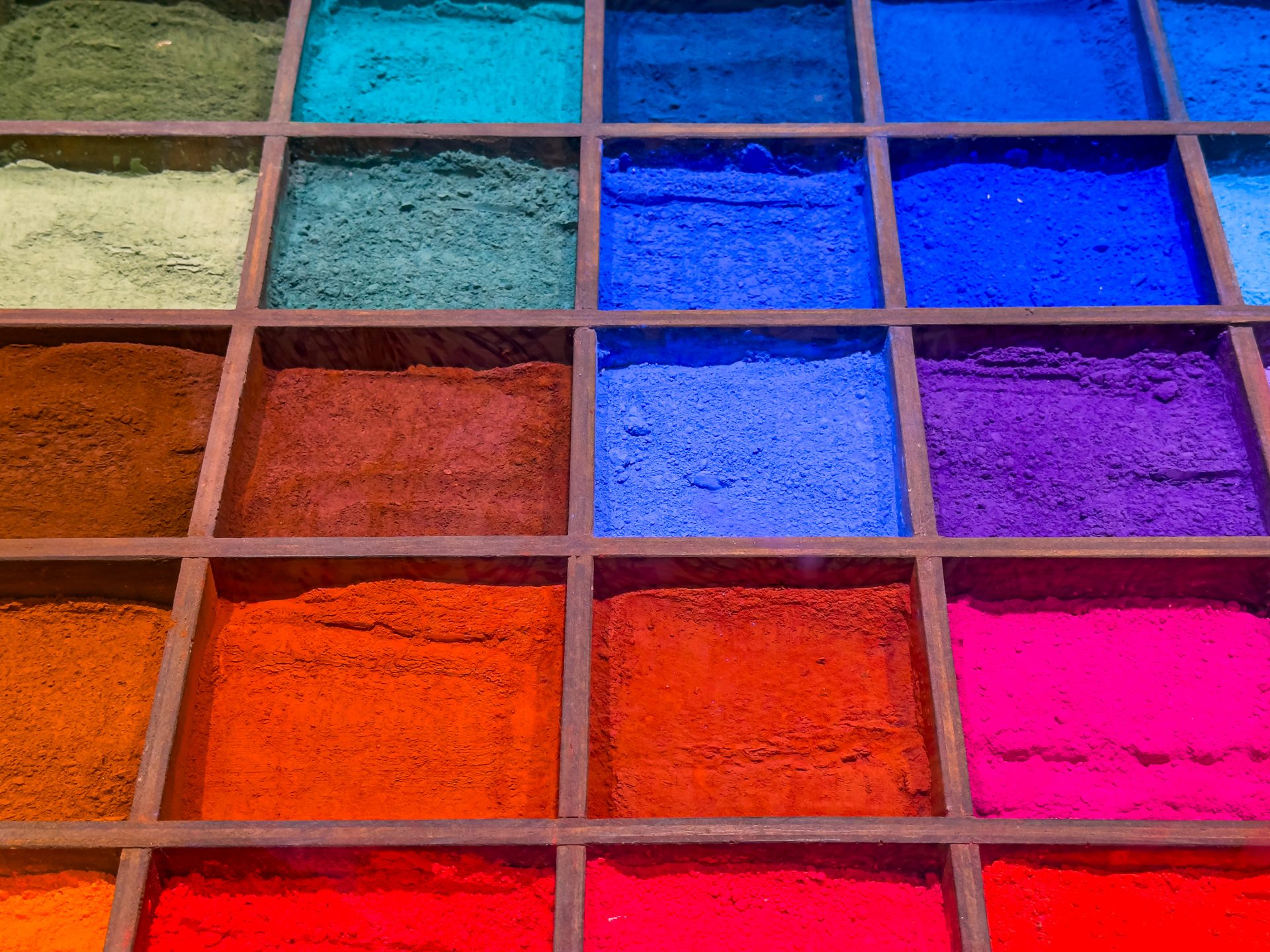
Cleanova Solutions for Pigment & Dye Manufacturing and Specialty Chemicals
Technologies are organized by filtration function rather than by product family, so a process engineer can move from the separation duty to the equipment and media that serve it.
Filtration Technologies
| Filtration Area | Typical Technologies |
|---|---|
| Liquid Filtration | Cartridge Filters, Liquid Bag Filters, Self-Cleaning Filters, Automatic Filters |
| Liquid-Solid Separation | Filter Press Cloth, Innovative Feednecks (e.g. OMNI™ Feedneck Assembly), Filter Presses, Vacuum Filters, Filter Belts, Disc Filters |
| Air & Gas Filtration | Baghouse Filter Bags, Gas Filtration, Coalescers, Dust Collection Solutions |
| Cleanova.CARE™ Lifecycle Services | Process Optimization, Filter Media Evaluation, In-House Laboratory Testing |
Why Filtration Matters in Chemical Manufacturing
Filtration is not a single process step, it is a critical performance driver throughout chemical manufacturing. From raw material preparation and process clarification to dewatering, emissions control, and final product recovery, filtration influences product purity, production throughput, energy consumption, media life, and total operating costs. Optimizing each filtration stage can unlock significant improvements in plant performance and profitability.
Common Filtration Challenges
Manufacturers commonly encounter ultrafine particle retention, difficult cake release, cloth blinding, abrasive slurries, variable particle size distributions, high cake moisture, long cycle time, and cross-contamination. These challenges rarely originate from a single piece of equipment. They are often the result of interactions between process conditions, filter media, equipment design, and operating practices. Solving them requires a partner capable of evaluating the complete filtration process, not simply recommending a replacement filter cloth or cartridge.
Titanium Dioxide (TiO₂): Filtration at Every Stage
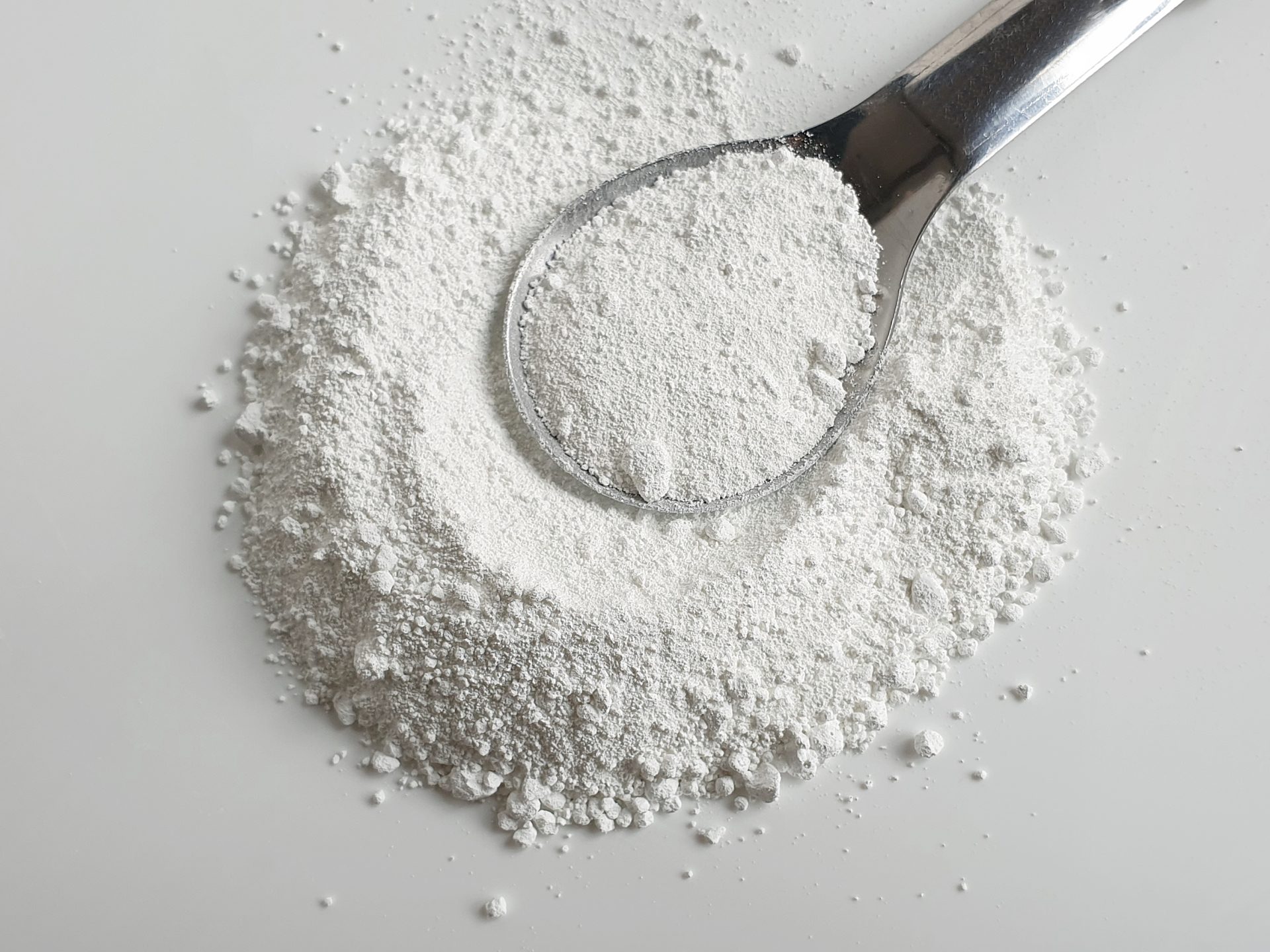
Titanium dioxide manufacturing is one of the most filtration-intensive processes in the chemical industry. Depending on the production route, filtration and separation are required throughout the process—from raw material preparation and gas cleaning through purification, pigment precipitation, washing, dewatering, drying and final product handling.
TiO₂ is primarily produced using two established process routes: the chloride process and the sulphate process. While the chemistry and process configuration differ, both rely on multiple filtration technologies to separate solids from liquids, recover valuable process materials, control emissions and produce pigment with the required purity and physical properties.
Chloride Process
The chloride process uses chlorine gas to convert titanium-bearing feedstock into titanium tetrachloride (TiCl₄), followed by purification, oxidation and pigment finishing. Filtration occurs at multiple points, handling both wet and dry separation duties.
Key Filtration Applications in the Chloride Process
- Dust collectors — particulate control and material recovery during dry handling operations.
- Filter presses — dewatering of solid waste generated during TiCl₄ processing.
- Candle filters — removal of suspended solids and precipitated contaminants from crude liquid TiCl₄ before distillation.
- Dust collectors and pulse-jet filters — protection of downstream air-separation equipment.
- Cyclones and dust collectors — separation of fine TiO₂ particles from chlorine-rich gas following oxidation.
- Rotary drum vacuum filters and vacuum leaf filters — pigment washing and dewatering.
- Vertical tower presses and vacuum filtration — additional dewatering before drying, milling, and packaging.
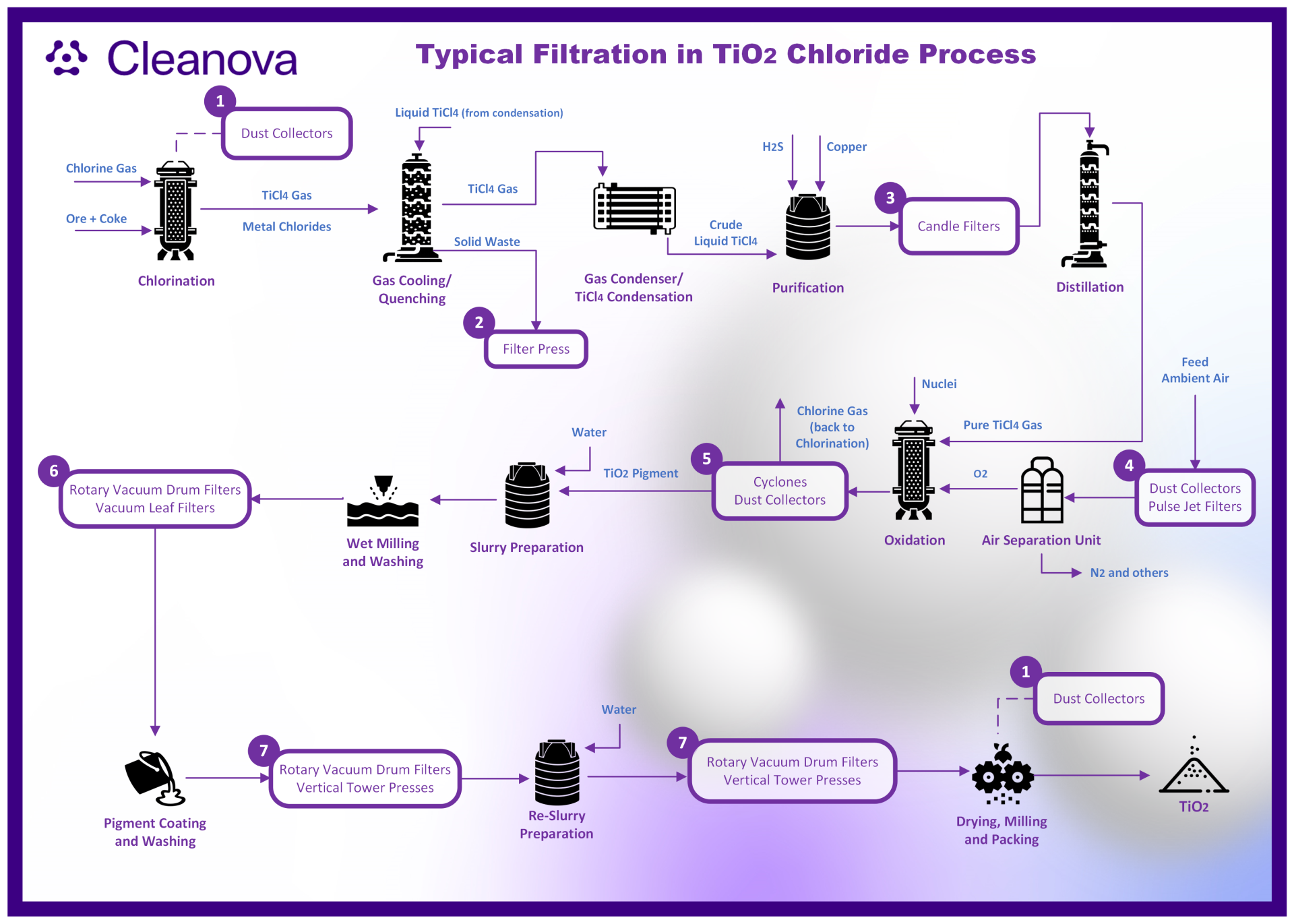
Typical Filtration in TiO₂ Chloride Process
Separation duties appear from feedstock handling through chlorination, TiCl₄ purification, oxidation and pigment finishing. Each stage places different demands on media, cake handling and gas-side particulate control.
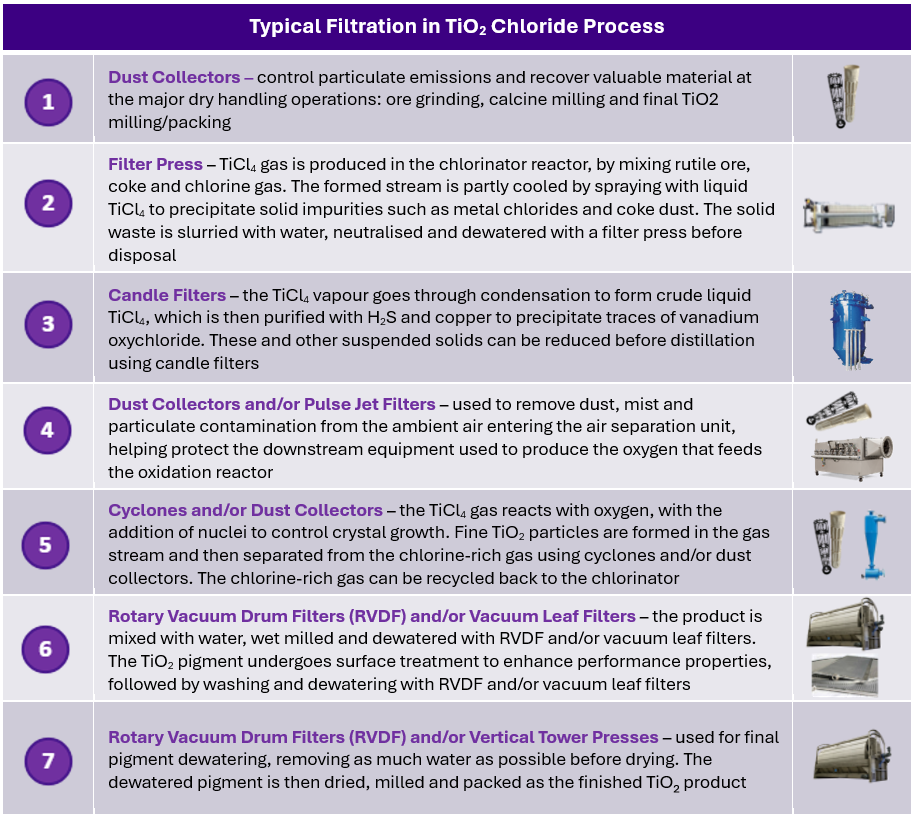
Products and Applications Detail
The equipment and media serving each duty point, mapped to the process stages above — dust collectors, filter presses, candle filters, rotary drum vacuum filters and vertical tower presses.
Sulphate Process
The sulphate process follows a different chemistry, beginning with ilmenite digestion in sulfuric acid. Filtration and separation are used through settling, pigment precipitation, washing, dewatering and finishing.
Key Filtration Applications in the Sulphate Process
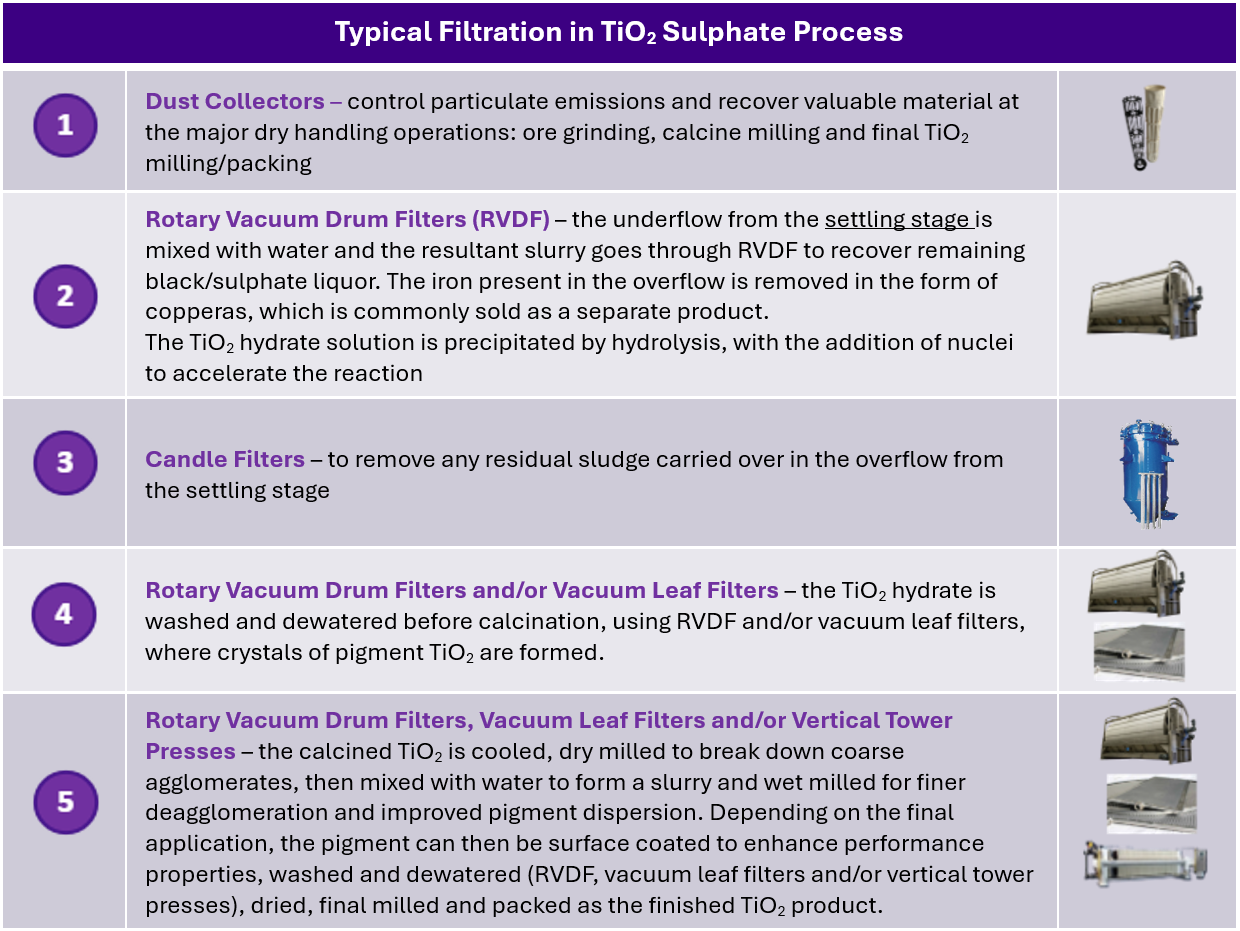
- Dust collectors — particulate control during ore grinding, calcine handling, dry milling and final product handling.
- Rotary vacuum drum filters — recovery of process liquor and separation of solids following settling.
- Candle filters — removal of residual sludge from process liquor.
- Rotary vacuum drum and vacuum leaf filters — washing and dewatering TiO₂ hydrate before calcination.
- Rotary vacuum drum filters, vacuum leaf filters and vertical tower presses — dewatering following pigment coating and washing.

Typical Filtration in TiO₂ Sulphate Process
Ilmenite digestion in sulfuric acid sets up a different separation profile: settling, liquor clarification, hydrate washing and dewatering, then finishing and dry handling.
Products and Applications Detail
The equipment and media serving each duty point, mapped to the process stages above — dust collectors, rotary vacuum drum filters, candle filters, vacuum leaf filters and vertical tower presses.
Why TiO₂ Filtration Requires a Process-Level Approach
The filtration challenges in TiO₂ production are not confined to a single piece of equipment. Particle size, solids concentration, slurry characteristics, chemical compatibility, cake formation, washing requirements and moisture targets can change significantly from one process stage to the next.
A candle filter used in TiCl₄ purification has very different requirements from a rotary drum vacuum filter used for pigment washing and dewatering, while dust collectors and pulse-jet filtration systems address particulate control in dry handling and gas streams.
Cleanova brings together filtration technologies spanning these applications, enabling engineers to evaluate filtration as part of the complete process rather than as an isolated equipment purchase.
Beyond Titanium Dioxide
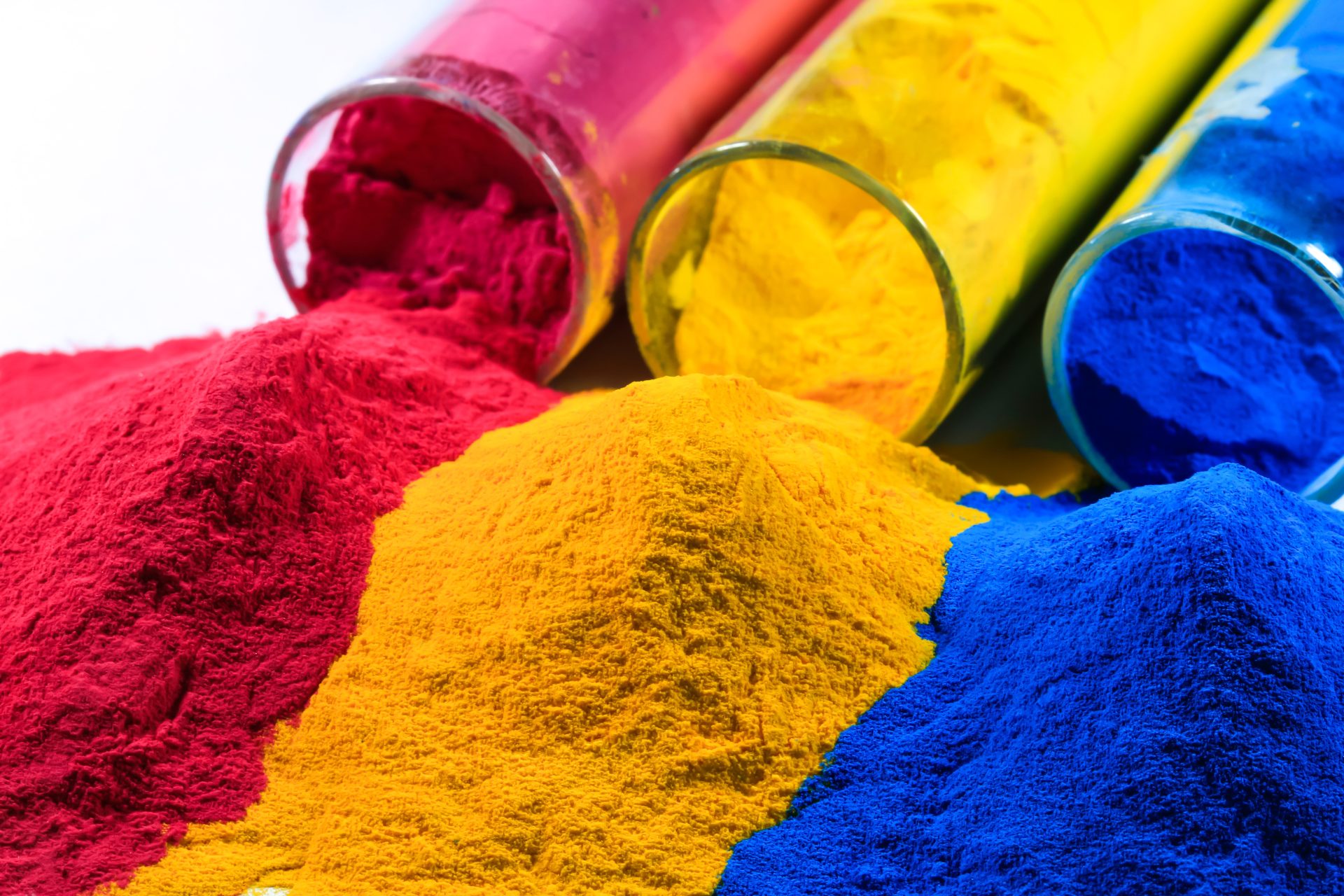
Many of the same filtration challenges occur in iron oxide pigments, carbon black, azo pigments, phthalocyanine pigments, specialty pigments, dye intermediates, and other specialty chemical processes. Cleanova applies its process expertise across these applications.
Selecting the Right Filtration Solution
System design should consider particle size distribution, solids loading, slurry viscosity, chemical compatibility, washing requirements, desired cake moisture, throughput objectives, maintenance strategy and lifecycle cost.
One Partner. Complete Filtration Expertise.
Many suppliers specialize in one filtration technology. Cleanova brings together expertise across liquid filtration, liquid-solid separation, air and gas filtration, engineered filter media, filtration equipment, laboratory testing and lifecycle optimization.
This breadth enables our engineers to evaluate the entire manufacturing process, identifying opportunities to improve recovery, increase throughput, reduce maintenance, lower emissions and decrease total cost of ownership.
Rather than optimizing one filter, Cleanova helps optimize the complete filtration system.
Whether producing titanium dioxide, pigments, dyes or specialty chemicals such as hydrogen peroxide or nitric acid, chemical manufacturers benefit from a filtration partner capable of improving product quality, increasing throughput, and reducing total cost of ownership.
Whether optimizing an existing filtration process or designing a new production line, Cleanova’s filtration specialists can evaluate your complete filtration system and recommend opportunities to improve recovery, throughput, reliability, and operating costs. Our broad technology portfolio and process expertise make Cleanova an ideal partner for demanding chemical processing applications.
Need to evaluate filtration performance in your chemical process?
Cleanova engineers can assess filtration media, equipment configuration and operating conditions to identify opportunities for improved recovery, throughput and reliability.
