

Engineers specifying liquid filtration systems often face a practical problem: two filter elements may carry the same micron designation but perform very differently when the system must maintain a target cleanliness level. The selection decision also depends on fluid conditions, flow rate, pressure-drop limits, contaminant loading, and the sensitivity of downstream components.
A beta ratio filter rating is one of the most useful ways to quantify filter element efficiency, but it is also commonly misinterpreted. Correct specification depends on understanding what the beta ratio means at a given particle size, how it translates to efficiency, how the performance was tested, and how it relates to the cleanliness level the system needs to maintain.
What Is a Beta Ratio?
The beta ratio measures a filter’s particle removal efficiency at or above a stated particle-size threshold by comparing the upstream particle count to the downstream count at that same size.
β(x) = C₀ / C
In this equation, C₀ is the upstream particle count at particle size x, and C is the downstream count at that same size.
A beta ratio is only meaningful alongside its micron size. For example, a beta ratio of 75 at a 20-micron particle-size threshold means that, for every 75 particles of 20 microns and larger entering the filter, approximately one particle of 20 microns and larger is measured downstream.
A single filter element may carry several beta ratios across a range of particle sizes. The ratio and the particle-size threshold therefore need to be read together.
Converting Beta Ratio to Efficiency Percentage
The relationship between beta ratio and removal efficiency is:
Efficiency (%) = [(β − 1) / β] × 100
A small change in efficiency percentage at the high end represents a significant reduction in downstream particle count. A beta ratio of 100 corresponds to 99% efficiency, while a beta ratio of 1,000 corresponds to 99.9% efficiency. At the same upstream particle count, the downstream count falls from 10 particles to approximately 1 particle per 1,000.
| Beta Ratio (β) | Efficiency (%) | Particles of a given size that pass through the filter |
| 2 | 50.0% | 1 of 2 particles |
| 10 | 90.0% | 1 of 10 particles |
| 20 | 95.0% | 1 of 20 particles |
| 50 | 98.0% | 1 of 50 particles |
| 75 | 98.7% | 1 of 75 particles |
| 100 | 99.0% | 1 of 100 particles |
| 200 | 99.5% | 1 of 200 particles |
| 1,000 | 99.9% | 1 of 1,000 particles |
| 2,000 | 99.95% | 1 of 2,000 particles |
| 5,000 | 99.98% | 1 of 5,000 particles |
The particle-passing figures are calculated averages. Fractional values and rounded figures represent expected results over repeated counts rather than literal fractions of individual particles.
How ISO 16889 Evaluates Beta Ratio Performance
A single beta-ratio reading only shows part of the filter’s performance. ISO 16889’s multi-pass test method evaluates particulate removal, contaminant capacity, and differential pressure while the contaminant is continuously injected into the test circuit. Automatic particle counters measure upstream and downstream particle concentrations as the element loads.
The test is performed under controlled laboratory conditions and provides a standardized method for evaluating liquid filter performance. However, actual performance in service can vary depending on operating conditions such as fluid properties, contaminant characteristics, flowrate, temperature and pressure.
The key specification question is whether the published ratio remains representative as the element loads. An early beta-ratio result does not necessarily describe performance across the full loading curve. Performance across the loading cycle therefore provides more useful information than a single early reading.
When reviewing manufacturer data, ask whether the published figure is:
- A single-point reading
- An average over a defined test period
- A minimum or sustained ratio
- Reported together with the loading curve and differential-pressure trend
This distinction matters because an initial result may not represent the element’s performance throughout the loading cycle. The loading curve and differential-pressure trend provide context for how the beta ratio behaves as contaminant accumulates.
Nominal vs. Absolute Rating
A beta ratio only tells the full story when considered alongside the stated micron rating and how that rating is defined. Two cartridges may both be described as 10 micron, for example, while having very different particle removal efficiencies.
A nominal rating describes an approximate removal capability at a stated micron size. However, there is no single efficiency associated with a nominal rating and the definition can vary between manufacturers and test methods.
An absolute rating indicates a more defined level of particle removal performance at the stated micron size. The efficiency or beta ratio used to define an absolute rating should be clearly stated by the manufacturer.
This is where beta ratio provides useful context. As described above, beta ratio converts directly into particle removal efficiency. For example, β100 corresponds to 99% efficiency, β1000 to 99.9% and β5000 to 99.98%. Therefore, a filter described as 10 micron absolute at β5000 has a much more clearly defined performance than a filter described as 10 micron nominal.
Key Information For Filter Selection
Filter selection should begin with a clear understanding of the application conditions. Information such as fluid composition, flow rate, temperature, viscosity, solids loading, required filtration level, and allowable differential pressure is needed before filter performance data can be meaningfully assessed.
Once the application requirements are defined, the following information can help determine whether a filter element is suitable.
| Information | Relevance to the specification |
| Particle-size rating | Identifies the micron size at which filter performance is reported |
| Rating type | Establishes whether the micron designation is nominal or absolute |
| Beta ratio / efficiency | Defines the particle removal performance at the stated micron size |
| Test method / basis | Identifies how the filtration performance was established |
| Performance across loading | Shows how filtration performance changes as the element loads |
| Dirt-holding capacity | Indicates how much contaminant the element can retain under the stated test conditions |
| Differential-pressure limits | Helps define the operating and changeout limits of the element |
| Materials / construction | Confirms compatibility with the process fluid and operating conditions |
How Cleanova Documents Beta Ratio and Micron Rating
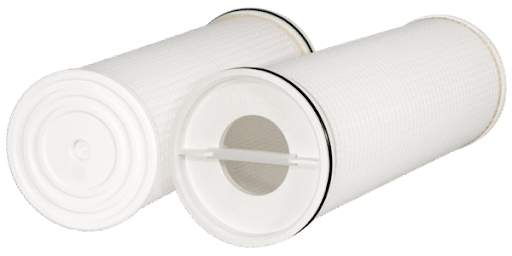
Cleanova’s CleanMax product datasheet states that its high-flow cartridge filters are available with absolute Beta 5000 performance, equivalent to 99.98% efficiency, across listed 1, 2, 5, 10, 20, and 40 µm ratings. The datasheet presents the beta ratio alongside the micron rating, media, construction, operating limits, and ordering information, providing the following product-specific rating information:
| Parameters | Information |
| Beta performance | Absolute Beta 5000, equivalent to 99.98% efficiency |
| Absolute micron options | 1, 2, 5, 10, 20, and 40 µm |
| Filter media | Polypropylene and glass microfiber |
| Maximum differential pressure | 2.5–3.0 barg changeout range |
These specifications apply to the CleanMax product line and should not be assumed to apply to other Cleanova element lines.
Frequently Asked Questions
What beta ratio counts as absolute filtration?
The minimum beta ratio used to define an absolute rating varies by manufacturer. The beta value, particle-size threshold, and test method provide the basis for interpreting the designation.
Is a higher beta ratio always better?
A higher beta ratio at the required micron size is only one part of the selection decision. Dirt-holding capacity, performance across loading, initial pressure drop, fluid compatibility, operating conditions, service life, and cost also affect suitability.
Can two filters with the same micron rating have different efficiencies?
Yes. Two filters can have the same stated micron rating but very different particle removal efficiencies. The rating type, beta ratio or stated efficiency, and test basis should be reviewed to understand the actual filtration performance.
Specify With Verified Data
A beta ratio carries meaning when it is tied to a specific particle size, rating type, test condition, and application requirement.
Talk to a Cleanova filtration expert
To review beta-ratio data alongside contamination loading, flow, pressure-drop limits, and capacity before a filter-element specification is finalized.