
Liquid/liquid coalescers play an important role in oil and gas processing, where removing water from hydrocarbon streams can be critical to product quality, downstream equipment protection, and reliable operation. Whether you’re specifying a new separation system or replacing coalescer elements in an existing vessel, selecting the right configuration starts with understanding the current process, not simply matching the original element dimensions. Typical applications include water removal from condensates, diesel and other hydrocarbon streams, hydrocarbon recovery, and amine or glycol service.
For oil and gas operators, process conditions can change significantly over the life of a separation system. Flow rates may increase, water loading may change, chemical treatment may be different, and operating temperatures may shift. An element that was correctly specified years ago may no longer be the best fit for the current application.
Cleanova approaches liquid/liquid coalescer selection as an application decision, not simply an element replacement. Our engineers evaluate the hydrocarbon/water stream, required outlet water content, operating conditions, and pressure-drop requirements to determine the appropriate coalescer configuration.
Five Factors Cleanova Evaluates When Selecting a Liquid/Liquid Coalescer
The most important application variables are:
- Flow rate
- Droplet size distribution
- Water content target
- Operating temperature
- Pressure drop
These parameters determine the separation duty and help establish the appropriate element, vessel, and system configuration.
1. Start With the Current Flow Requirement
Flow rate establishes the hydraulic load on the coalescer and influences element count, vessel size, and overall configuration.
But the number that matters isn’t always the flow rate printed on the original equipment specification.
Cleanova recommends reviewing the full operating envelope, including:
- Normal flow
- Peak flow
- Minimum flow and turndown
- Batch or intermittent operation
- Relevant upset or liquid-loading conditions
Capacity should also have a clear basis. A stated flow rating may apply to an individual element, a vessel, or a complete arrangement. Those are not necessarily interchangeable.
Why it Matters
Under-sizing can contribute to water carryover, higher pressure drop, or shortened element life. Over-sizing can add unnecessary vessel, element, and operating costs without improving separation.
Cleanova’s UNIQ-FLOW™ liquid/liquid coalescers can be configured for applications with rated flows typically up to 3,000 USgpm, depending on the selected element, vessel, and complete system arrangement.
The appropriate capacity should be based on the actual operating envelope, not simply the maximum published flow rate.
2. Understand the Droplets You’re Trying to Remove
A liquid/liquid coalescer is separating dispersed water from a hydrocarbon stream. The size and distribution of those water droplets are therefore critical to selection.
Droplet characteristics can change as the stream moves through pumps, valves and other upstream equipment. Chemical treatment, viscosity, mixing conditions, and other process variables can also influence droplet formation.
Why it Matters
Droplet formation can affect more than separation performance. In UNIQ-FLOW™ testing, larger droplets formed during coalescence allowed Cleanova engineers to shorten the separation distance and reduce overall vessel length while maintaining the required separation efficiency. This can support a more compact, cost-effective separation system.
Larger water droplets are generally easier to separate than smaller dispersed droplets. If the actual stream contains finer droplets than expected, a coalescer selected from an overly simplistic specification may not deliver the required outlet performance.
This is also why a nominal media rating should not be treated as a direct indication of liquid/liquid separation performance.
Media retention and liquid/liquid droplet separation are different performance considerations.
What Cleanova Evaluates
Where representative data is available, Cleanova considers the droplet distribution together with:
- Sample location and operating conditions
- Pump and valve conditions
- Chemical treatment
- Hydrocarbon viscosity
- Upstream separation
- The required outlet water content
The goal is to evaluate the coalescer against the actual separation challenge rather than selecting from a media rating alone.
3. Define What “Dry Enough” Actually Means
The required outlet water content is one of the most important parts of the specification.
Depending on the application, the requirement may be expressed as water-in-oil (WIO) ppm, BS&W (Basic Sediment and Water), free water, or another plant, customer, or pipeline specification.
These measures should not automatically be treated as equivalent. The measurement basis, units, test method, and sample point need to be clearly defined.
Why it Matters
A statement such as “remove the water” isn’t enough to establish the required separation duty.
The coalescer specification should identify:
- Hydrocarbon being treated
- Inlet water concentration
- Required outlet water content
- Measurement basis and units
- Sample point
- Test method
- Operating conditions
- Performance acceptance criteria
For crude oil applications, ASTM D4928 provides a method for determining water in crude oil over a defined measurement range. The applicable customer, pipeline, or process requirement ultimately determines the required outlet limit.
Don’t confuse a test result with a guarantee
Performance figures such as 10 ppm or 20 ppm should always be considered in the context of the test conditions.
Cleanova evaluates coalescer performance using jet fuel and ATEX test methods, with three tests performed on each coalescer to calculate average efficiency.
UNIQ-FLOW™ coalescers are available with 10 ppm and 20 ppm outlet water performance options. Those results require application review before being applied to crude, condensate, or chemically treated streams.
In other words, the right question isn’t simply, “Can this coalescer achieve 10 ppm?”
It is:
“Can the selected coalescer achieve the required outlet water content in my actual application?”
4. Design for the Full Operating Temperature Range
Temperature affects hydrocarbon viscosity and the conditions under which water separates from the stream.
That’s why selection should account for more than normal operating temperature.
The relevant operating profile may include:
- Normal operating temperature
- Minimum and maximum temperature
- Startup and shutdown
- Seasonal conditions
- Hydrocarbon viscosity
- Material and seal limitations
- Potential condensation
- Wax or solids risk where applicable
Why it Matters
A system that performs well at normal operating temperature may behave differently during a cold startup or other off-design condition. Changes in viscosity can affect separation performance and pressure drop, while temperature extremes can affect materials, seals, and media.
UNIQ-FLOW™ vessel design temperature is typically up to 80°C, while media service temperature can be up to 200°C, depending on the selected materials and configuration.
5. Manage Pressure Drop Across the Operating Life
Pressure drop is more than a number on a datasheet. It affects available process margin, pump duty, maintenance timing, and ultimately how the coalescer performs in service.
Cleanova recommends evaluating differential pressure at the actual flow, temperature, viscosity, and liquid-loading conditions.
A useful review considers:
- Clean differential pressure
- Operating differential pressure
- Alarm point
- Change-out point
- Maximum allowable differential pressure
Why it Matters
Upstream pre-filtration can also help protect coalescer elements from excessive contaminant loading and support longer service life. Changeout should be based on the application’s established differential-pressure limit rather than on time alone.
Rising differential pressure can indicate element loading, drainage problems, flow maldistribution, or an element approaching change-out.
Looking only at the maximum allowable differential pressure doesn’t tell you how the coalescer will actually operate.
For that reason, clean and loaded pressure-drop performance should be evaluated as part of the application, not treated as a standalone product specification.
Replacing an Existing Coalescer? Look Beyond Dimensions.
A replacement element needs to fit the equipment. But dimensional compatibility does not establish application compatibility.
Before re-elementing an existing coalescer, Cleanova recommends reviewing available information on:
- Current flow rate and operating range
- Water loading
- Hydrocarbon properties
- Operating temperature
- Chemical treatment
- Historical differential pressure
- Maintenance and element-changeout history
- Original equipment specifications
This information can reveal whether the existing coalescer configuration is still appropriate, or whether changing process conditions have created a different separation requirement.
It can also help identify problems that may not be caused by the element itself, including drainage issues, upstream separation, or flow distribution.
That’s where an experienced coalescer supplier can add value beyond simply supplying a replacement element.
Cleanova supports process engineers, facility teams, and procurement organizations from initial coalescer selection through replacement, re-elementing, and performance review.
Our approach combines application review, coalescer technology, and ongoing replacement support to help customers maintain separation performance as operating requirements evolve.
For new installations, that means selecting the coalescer around the actual process.
UNIQ-FLOW™ elements are available with pleated polymer or glass-fiber filtration media, with configurations selected to suit the application.
For replacement applications, it means looking at current operating conditions rather than simply reproducing an old specification.
For systems experiencing declining performance, it means evaluating the application and equipment together to determine where the problem may be occurring.
UNIQ-FLOW™ Liquid/Liquid Coalescers
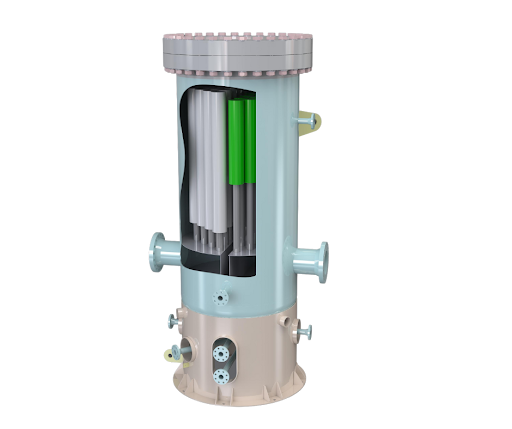
Cleanova’s UNIQ-FLOW liquid/liquid coalescers are designed for hydrocarbon/water separation applications and can be configured to meet a range of process requirements.
Flow: Rated flow is typically up to 3,000 USgpm.
Outlet water performance: 10 ppm and 20 ppm options are available.
Temperature: Vessel design temperature is typically up to 80°C, with media service temperature up to 200°C depending on materials and configuration.
Vessel construction: Options include carbon steel, stainless steel, duplex, super duplex, and Alloy 625 or 825 clad construction.
Pressure drop: Clean and loaded performance is evaluated based on the application and stated operating conditions.
Design Code: ASME VIII Division 1/2 requirements, including U-1A.
The appropriate configuration depends on the hydrocarbon/water stream, required outlet performance, and operating conditions.
The Right Coalescer Starts With the Right Application Data
The best coalescer isn’t necessarily the one with the highest capacity, the lowest initial cost, or the same specifications as the element it replaces.
It’s the one selected for the actual process it needs to handle.
Flow rate establishes the hydraulic duty. Droplet size defines the separation challenge. Water content establishes the required outlet quality. Temperature defines the operating conditions.
Pressure drop helps determine how the system will perform over time.
Cleanova helps engineers and procurement teams connect those variables to the right coalescer configuration, and provides the replacement and technical support needed throughout the life of the system.
Need to specify or replace a liquid/liquid coalescer?
Talk to one of Cleanova’s filtration experts today.